
← News
“Youth, Heritage, and the Climate Cost of What We Wear” at Bangkok Climate Action Week

Bangkok, 4 October, 2025 — The Southeast Asian Cultural Heritage Alliance’s youth panel discussion put the fashion industry under the microscope and critically examined its relationship with climate responsibility. Entitled “Youth, Heritage, and the Climate Cost of What We Wear,” the event drew in ASEAN youth leaders, sustainable fashion enthusiasts, and an international audience eager to unpack clothing’s environmental and social footprint across Southeast Asia. Youth representatives hailed from countries such as Myanmar, the Philippines, Thailand, and Vietnam, and were joined by moderator Fauzy Ismail of SEACHA and guest discussant Alka Puri of Fashion Rethink.
The event opened with a keynote presentation from Puri entitled, “Fashion Choices and Climate Responsibility.” She began with a contextual glimpse into the global fashion economy, recognizing its massive profitability and noting that the Asia-Pacific region commands a staggering 40% of the market. Nevertheless, these substantial numbers still come with a significant cost, whereby fashion’s linear manufacturing model leaves behind a long trail of climate damages. Puri detailed the effects, highlighting key environmental burdens such as pesticides poisoning cotton fields, rivers polluted by textile dyes, polyester clogging landfills, and heaps of unsold clothes incinerated before ever being worn.
Her critique also extended to social issues, such as gender discrimination in factories, rampant overconsumption, and the waste of underutilized clothing. As she warned, “We’re buying more, but we’re using less — and when we buy more, the industry makes more money,” underscoring how fast fashion profits from disposable habits. Yet in the face of this seemingly disheartening news, she still offered a blueprint for change by suggesting various key solutions for both suppliers and consumers, including circular business models, resource recycling, renewable energy, natural fabrics, non-toxic dyes, regional buying habits, fewer e-commerce returns, sustainable heritage design practices, and climate justice that protects workers as much as the planet. “Don’t be discouraged,” she urged. “There’s still a lot we can do — you have a lot of choices in your hands to make an impact.”

The youth panel portion of the event brought a unique and modern perspective to the conversation at hand. First to present was Supitcha Suttanonkul of Thailand, who approached the issue through the lens of a designer. She told the story of a Bangkok innovator who creatively transforms discarded mechanical parts in his neighborhood into wearable clothing, demonstrating that materials once seen as waste can become statements of sustainability. “If you look at something as trash, it becomes trash forever,” she explained. “But if you experiment with it, you can make something beautiful out of what people throw away.” Supitcha contrasted this approach with the heavy environmental toll of conventional materials and also highlighted rural weavers who rely on natural fibers instead of synthetic fast-fashion textiles. Her message was clear: both designers and consumers hold the power to choose sustainable fashion, and those choices must ripple through every level of the fashion economy, from policy to education and everyday life.
From Vietnam, Celia Bùi Lê shifted the focus to the factory floor. As she reminded the audience, Vietnam is a global giant in clothing manufacturing, surpassing China in sneaker production and ranking third worldwide in textile exports. But behind this success lies a troubling legacy: wages stuck at half the living standard, unsafe working conditions, corporal punishment scandals, and a lack of independent unions. “Behind every garment we wear is a lot of effort — and a lot of love,” she emphasized, urging consumers to see the human stories hidden in their closets.
Celia acknowledged improvements in recent years, such as safer workplaces, timely pay, and more progressive policies — developments largely driven by consumer pressure on brands to act ethically. “Consumer pressure does work,” she noted, pointing to how compliance standards have improved factory practices. Yet climate change continues to batter garment workers. Waste disposal from mass production has birthed so-called “cancer villages,” while extreme flooding and rising temperatures make factory life increasingly dangerous. “When we talk about climate change, we’re not just talking about the earth,” Celia stressed. “We’re talking about creating better living conditions for the people who make our clothes.”



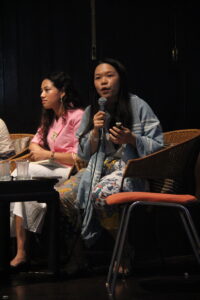
Next up, Myanmar’s Shar Thae Hoy offered an in-depth account of how politics and economics have reshaped her country’s fashion industry in recent years. She described life before the COVID-19 pandemic and the 2021 military coup d’état, when Myanmar attracted foreign investment from industry giants such as H&M and Zara. Today, that investment has dried up, wages have fallen, and job insecurity looms large.
Shar then painted a consumer landscape where young people chase fast-fashion trends, second-hand bargains, and cheap imports from China. While many desire to support local brands, homegrown products remain costly, under-promoted, and unstable in the market. Traditional practices like passing clothes down through generations still persist, but social media has successfully fueled a culture of overconsumption. “Young people are driven into fast fashion by trends,” she explained, “but sustainable products are often too expensive and inaccessible.”
She also emphasized the vast difference in priorities when coming from a country in the midst of such political upheaval. “In Myanmar today, survival is more important than sustainable fashion,” Shar explained, noting that climate-conscious choices become secondary when basic needs are at risk. Though Myanmar contributes little to global emissions, its people bear the brunt of climate impacts. Meanwhile, the traditional weaving industry struggles due to youth emigration and declining participation. Shar did express hope though that a greater sense of awareness might spark renewed interest in more locally produced, heritage-centered garments.
The final presentation came from the Philippines, where Gio Abcede introduced the concept of adaptive reuse — a principle borrowed from architecture and applied to fashion. For Gio, heritage is not merely history but a living resource embedded in everyday design. “There are existing resources everywhere that can be revived,” he explained, “and when we reuse heritage materials, we’re not just reducing waste — we’re keeping stories alive.” He described Filipino designers who draw on intergenerational traditions, transforming materials like pineapple fiber, old tablecloths, and curtains into contemporary clothing.
Gio also spoke about reimagining traditional garments to suit modern tropical life. “Traditional fabrics like the barong [tagalog] spend ninety percent of their life in a closet,” he said, “so the challenge became how to make these valuable garments part of daily wear again.” By experimenting with sleeveless designs, breathable cuts, and visible signs of wear, designers are making fashion both climate-responsive and culturally relevant. “Design doesn’t have to chase perfection,” Gio added. “History — stains, holes, and wear — can become part of the beauty.”
Beyond individual creativity, Gio highlighted nationwide initiatives through organizations like the Philippine Textile Institute, which promotes circular economy practices by transforming textile waste into usable fibers. “There are enough clothes on the planet right now to dress six generations of the human race,” he warned, “yet production keeps rising year after year,” underscoring the urgency of waste reduction and reuse.
The panel concluded with each youth speaker sharing their final takeaways, followed by a lively Q&A session with audience members. In sum, the event revealed fashion as both a culprit and a catalyst — a global industry with immense power to harm, but also to heal if designers, consumers, and policymakers prioritize sustainability, climate justice, and heritage conservation over unchecked consumption. The discussion ultimately posed a pressing question: in a world where clothing is essential to daily life, how can personal responsibility reshape fashion into a force for environmental and social good?